Cost Accounting
===============
Smarter's asynchronous workers persist detailed cost accounting information for all external service requests and responses.
This information can be used for billing, cost analysis, and budgeting purposes. Specifically, Smarter
tracks the following cost metrics:
.. raw:: html
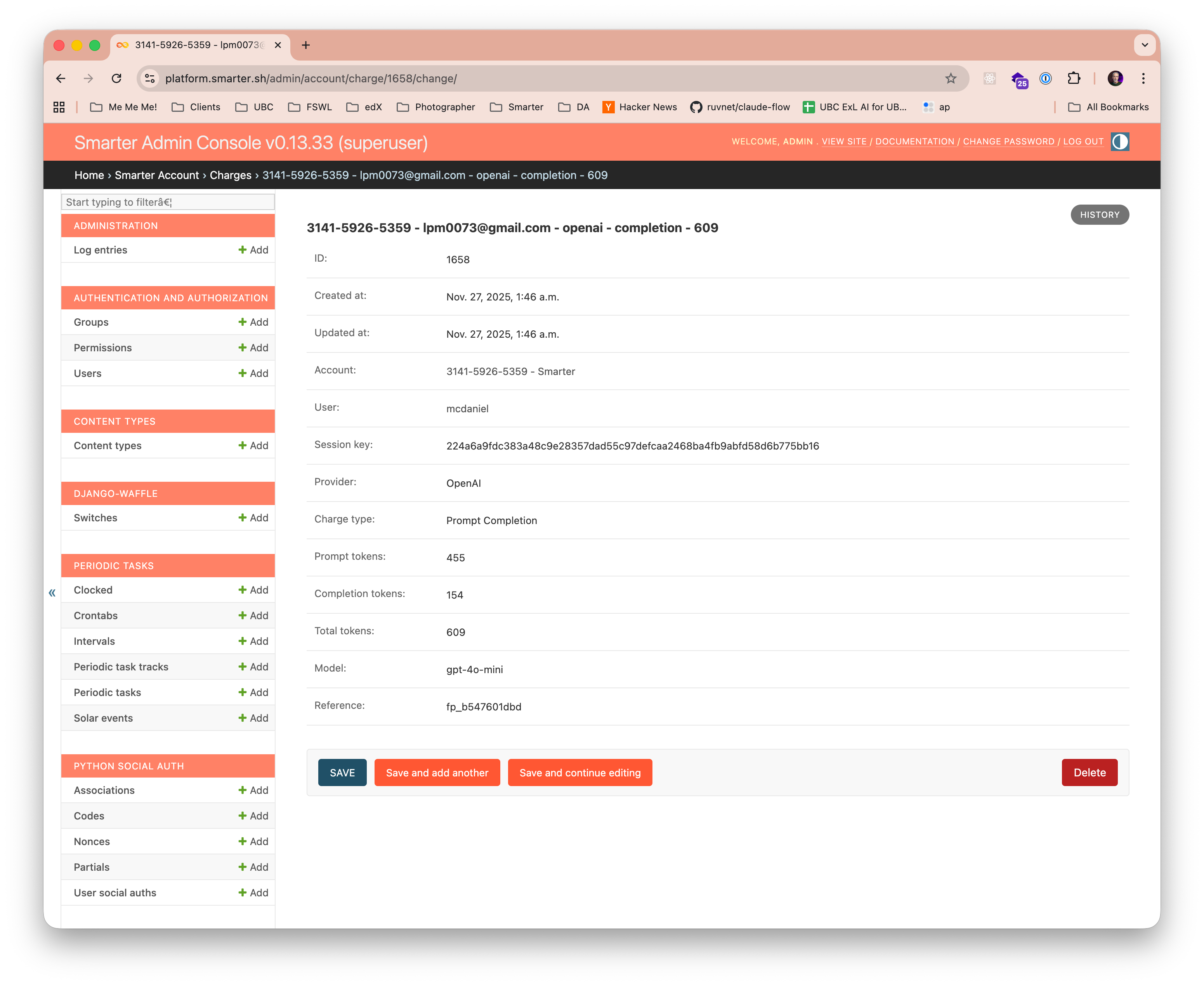 .. list-table:: Example Record
:header-rows: 1
* - Field
- Value
* - ID
- Smarter record identifier. ex 1658
* - Created at
- Smarter record create data. eg Nov. 27, 2025, 1:46 a.m.
* - Updated at
- Smarter record update date. eg Nov. 27, 2025, 1:46 a.m.
* - Account
- The Smarter account number. eg 3141-5926-5359 - Smarter
* - User
- The Smarter user identifier. eg mcdaniel
* - Session key
- The Smarter session key for the chat session. Use this to aggregate charges for a single chat session (conversation) eg 224a6a9fdc383a48c9e28357dad55c97defcaa2468ba4fb9abfd58d6b775bb16
* - Provider
- The LLM Provider. eg OpenAI
* - Charge type
- Smarter internal charge category. Values: Prompt Completion, Plugin, Tool
* - Prompt tokens
- The number of tokens in the prompt, for external billing purposes. eg 455
* - Completion tokens
- The number of tokens in the completion, for external billing purposes. eg 154
* - Total tokens
- The total number of tokens, for external billing purposes. eg 609
* - Model
- The Provider LLM model used for the request. eg gpt-6-luna
* - Reference
- External provider billing reference. eg fp_b547601dbd
Every user can read their own token usage, the series that the web console's dashboard charts, with
an api key: ``GET /api/v1/accounts/usage/?periodicity=24_hours`` returns the tokens and cost of their
LLM requests, one point per hour, day or month (``12_hours``, ``24_hours``, ``7_days``, ``1_month``
or ``1_year``), oldest first, as the Smarter SDKs do.
An example of a custom SQL query to aggregate token usage by session for a given month is shown below. Other
Django models associated with cost accounting include: `LLMClientRequests`, `PluginSelectorHistory`, and `Chat`.
.. code-block:: sql
USE smarter_platform_prod;
SELECT session_key,
SUM(prompt_tokens) as prompt_tokens,
SUM(completion_tokens) as completion_tokens,
SUM(total_tokens) as total_tokens
FROM account_charge
WHERE MONTH(created_at) = 11 AND
YEAR(created_at) = 2025
GROUP BY session_key
Pricing
-------
Each charge has a ``total_cost``, in USD, that budgets which measure cost compare to their limits.
- **LLM tokens** are priced with the :doc:`LLMPrices `
model. A price is the cost in **USD per million tokens**, markup included, of a combination of
charge type (``completion``, ``plugin`` or ``tool``), provider and model:
.. code-block:: python
from decimal import Decimal
from smarter.apps.account.models import ChargeTypes, LLMPrices
LLMPrices.objects.create(
charge_type=ChargeTypes.PROMPT_COMPLETION.value,
provider="openai",
model="gpt-6-luna",
price=Decimal("0.60"), # USD per million tokens
)
LLMPrices.cost_of(ChargeTypes.PROMPT_COMPLETION.value, "openai", "gpt-6-luna", total_tokens=200_000)
# Decimal('0.12')
The provider is matched without regard to case. A charge whose charge type, provider and model
have no price costs nothing, so budgets that measure cost do not see it until a price is added.
Prices are not applied retroactively.
- **LLMHost compute** is charged hourly, by Celery Beat, at the compute's ``price_per_hour`` for
each of its ready nodes. A compute without a price is not charged.
Budgets
-------
A Budget is a set of spending limits, which is enforced on each of the resources that it is attached
to. A budget can be attached to anything that has a record locator, for example a user, an account,
an LLMClient, a Provider, a Proxy, an LLMHostCompute, a plugin, a connection or an MCPClient. A charge
is created for each resource that took part in a request, so a budget sees its resource's share of
the spending.
.. list-table:: Budget settings
:header-rows: 1
* - Setting
- Meaning
* - unit
- What the limits measure: ``cost``, in USD, or ``tokens``.
* - period
- The billing period of the periodic limit: ``hour``, ``day``, ``week`` (from Monday) or ``month``.
* - periodicLimit
- The most that may be spent in a billing period. 0 means no limit.
* - absoluteLimit
- The most that may be spent in total, from when the budget was attached. 0 means no limit.
* - duration
- The number of billing periods, from when the budget was attached, after which the budget
no longer applies to the resource. 0 means it always applies.
* - action
- ``block`` further charges when a limit is reached, or ``warn`` only.
* - warningThreshold
- The percentage of a limit at which the ``budget_warning`` signal is sent, once per billing period.
* - message
- What people are told when the budget blocks their request. Defaults to a description of the limit.
Budgets are managed by superusers, with a Budget manifest. ``spec.resources`` lists the resources that
the budget is enforced on, by kind and name, or by record locator. It is declarative: applying the
manifest again detaches the budget from the resources that are no longer listed.
.. literalinclude:: ../../../example-manifests/budget.yaml
:language: yaml
.. code-block:: console
smarter apply -f budget.yaml
smarter describe budget student_monthly_allowance
smarter get budgets
Enforcement
~~~~~~~~~~~
- A budget is evaluated each time a charge is created for one of its resources, and hourly by Celery
Beat. When spending reaches a limit, the resource is locked: further requests that would be
charged to it are refused.
- A lock for the periodic limit ends with the billing period. A lock for the absolute limit lasts
until the budget is raised, detached or deleted. A budget whose duration has ended no longer applies,
and removes its lock.
- An LLMClient's chat answers a refused prompt with the budget's message, without calling the LLM.
A plugin or MCP server that is over budget is not called, and the LLM is told why. The Proxy, the
prompt passthrough, vectorsearch and orchestrator APIs answer ``402 Payment Required``. An LLMHost
is not launched while its compute, owner or account is over budget; nodes that are already running
are not removed.
- Charges are created asynchronously, by Celery, so a request may go slightly over a limit before
the lock takes effect.
- The ``budget_warning``, ``budget_exceeded`` and ``budget_released`` signals of
:doc:`smarter.apps.account.signals ` can be used for notifications.
Budget versus actual
~~~~~~~~~~~~~~~~~~~~
- The web console's dashboard has a **Budget vs Actual** chart of the budgets that apply to the user,
or to the resources they may see.
- The **Budgets** page of the web console lists the budgets, with each resource's spending this
billing period and in total, and a chart of its last 12 billing periods.
- The dashboard API returns the same data, as JSON: ``POST /api/web/dashboard/budgets/`` for the status of
each budget, and ``POST /api/web/dashboard/budgets//series/?periods=12`` for a resource's
budget versus actual spending of each billing period.
Users see the budgets attached to themselves and to the resources they own. Staff also see those of
their account, its members and their resources. Superusers see every budget.