Application Security
How the application and its Helm chart control what each request, user, API key and LLM tool can do, and how they protect the platform’s data.
The Web Console and the APIs
The web console
The web console is a single-page React application (ADR-035),
served by Django. It reads and writes through the web console API, under /api/web/, which is
internal to the console:
Session authentication and CSRF. The console calls the API with the browser’s Django session cookie and a CSRF token.
GET /api/web/session/describes the session and sets the CSRF cookie; every request that changes something must send the token inX-CSRFToken. The session cookie isSecure,HttpOnlyandSameSite=Lax, and sessions are stored in Redis, not in the cookie.Signed-in users only. Every page and every list endpoint requires a signed-in user, and its responses are never cached.
Ownership. A list endpoint returns only the resources that the user owns or that are shared with them, by the same ownership rules as the REST API.
The REST API and deployed LLMClients
API keys. The REST API (
/api/v1/), which thesmarterCLI and the SDKs use, authenticates with Smarter API keys, sent asAuthorization: Token <key>. Smarter’s authentication class, built on Django REST Knox, also checks that the key is active, journals each use, and warns about keys past their maximum lifetime. Every endpoint requires authentication unless it says otherwise.Rate limiting. Every API is rate limited, per user and, for anonymous clients, per IP address, including the APIs that a deployed LLMClient serves to the pages that embed it. A client over its limit gets HTTP 429 with a
Retry-Afterheader. The limits areSMARTER_APP_API_THROTTLE_RATE_USER(default600/minute) andSMARTER_APP_API_THROTTLE_RATE_ANON(default120/minute);nonedisables one. See throttling.py.JSON only. API errors are always JSON, never Django’s HTML error pages, and Pydantic
SecretStrkeeps secrets out of API responses.
Signing in
Users sign in with a password, or with Google or GitHub (social auth). The authentication backends are:
AUTHENTICATION_BACKENDS = [
    "social_core.backends.google.GoogleOAuth2",
    "social_core.backends.github.GithubOAuth2",
    "django.contrib.auth.backends.ModelBackend",
]
A deployment can replace them with DJANGO_AUTHENTICATION_BACKENDS, e.g. with the multitenant
backends in smarter.lib.social_core.backends.multitenant (see Overrides). Passwords must
pass Django’s four validators: similarity to the user’s attributes, minimum length, common
passwords, and all-numeric. See User Management.
Smarter’s middleware
Smarter adds its own middleware where an AI platform, which serves many customer domains, needs more
than Django’s. The full chain is MIDDLEWARE in
settings/base.py.
Host validation and security headers.
SmarterSecurityMiddlewarereplaces Django’sSecurityMiddleware. It is first in the chain, and rejects with a 400 any request for a host that Smarter doesn’t serve (the platform’s own hosts, or a deployed LLMClient’s domain) before anything queries the database. See security.py.CORS.
SmarterCorsMiddlewarereplaces django-cors-headers’ middleware, and allows each deployed LLMClient’s own origins. See cors.py.Sensitive file blocking. Requests for
.env,.gitand similar files are refused. See sensitive_files.py.
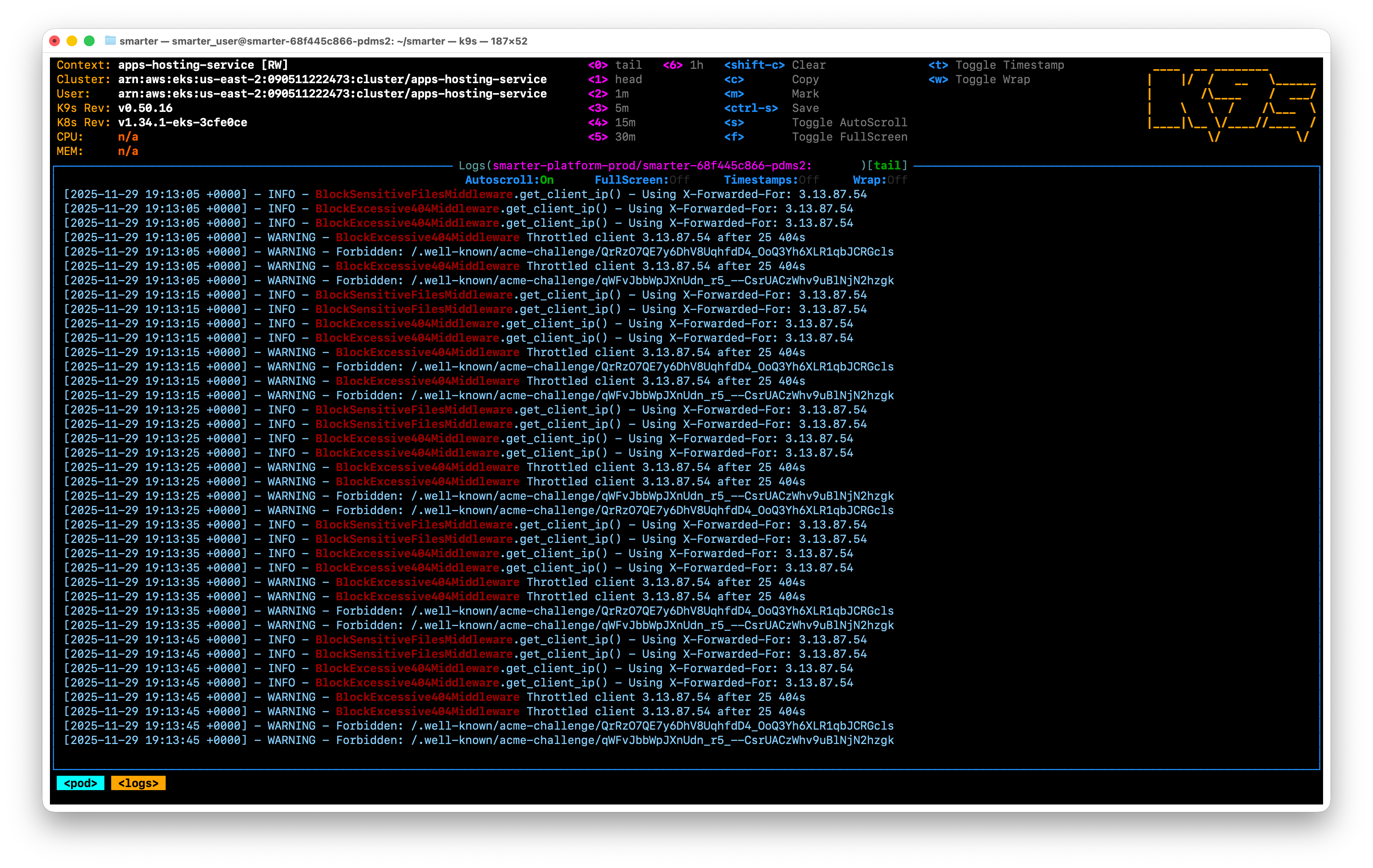
Excessive 404 protection. A client that requests many pages that don’t exist, as scanners do, is blocked. See excessive_404.py.
CSRF for deployed LLMClients.
SmarterCsrfViewMiddlewarecomputes the trusted origins for each request, so a deployed LLMClient’s own domains are trusted, then hands the check to Django’s CSRF middleware. It exempts a deployed LLMClient’s chat API and requests from inside the cluster’s network. See csrf.py.JSON errors.
SmarterJsonErrorMiddlewarereturns API errors as JSON. See json.py.
Django’s protections
HTTPS. Traefik redirects HTTP and sets HSTS (see Infrastructure Security), so
SECURE_SSL_REDIRECTandSECURE_HSTS_SECONDSstay unset in Django. Django learns that a request was HTTPS fromX-Forwarded-Proto(SECURE_PROXY_SSL_HEADER).Cookies. The session and CSRF cookies are
SecureandSameSite=Lax; the session cookie is alsoHttpOnly.Content Security Policy, in report-only mode: browsers block nothing yet, and report what the policy would block, which Smarter logs. Inline scripts carry a nonce. The policy will be enforced once the reports are clean. See
SECURE_CSP_REPORT_ONLYinsettings/base.py.Clickjacking protection with
X-Frame-Options.SQL injection: Smarter queries its own database through Django’s ORM.
XSS: Django’s templates escape their output, and React escapes what it renders.
The secret key.
DJANGO_SECRET_KEYsigns sessions and password reset tokens. Outside the local environment, Smarter refuses to start if it is missing or still aSET-MEplaceholder.
AI-specific protections
Guardrails inspect what passes between users and LLMs: they redact PII and secrets, and block prompt injection, jailbreaks and off-topic requests, before a message reaches the LLM or its tools, and before a reply reaches the user. See Smarter Guardrail.
Server-side request forgery. Tools that fetch URLs chosen by a manifest author or by the LLM (web search, skills, image search, MCP clients, API plugins, the extension registry, …) go through one hardened client,
safe_http: HTTPS on port 443 only, only to public addresses, with every redirect validated, no credentials in URLs, credential headers dropped on a redirect to another host, bounded response sizes and timeouts. This keeps them away from the cluster’s own network and the cloud’s instance metadata. An ApiConnection’s api may also use plain HTTP and its own port, but only at a public address. In the local environment, a developer’s MCP clients and API connections may also reachlocalhost. See safe_http.py.Signed extensions. The extension registry’s index is signed, and Smarter verifies its signature with
SMARTER_APP_LLMTOOL_EXTENSION_REGISTRY_PUBLIC_KEYon every read. See Managing Extensions.Cost accounting. The cost of every request to an external service, LLM providers included, is recorded per account. See Cost Accounting.
Data Protection
In transit: HTTPS for every request from outside the cluster; SMTP with TLS through SES; HTTPS for every call to an LLM provider.
Smarter Secrets (the API keys and passwords that resources use, see Smarter Secret) are encrypted with Fernet before they are saved, with
SMARTER_PLATFORM_FERNET_ENCRYPTION_KEY. Only the encrypted value is in the database, and in its backups. Keep the key: without it, a restored database’s Secrets can’t be read (see Backup and Restore).API keys are stored as a digest. The key itself is shown once, when it is created, and may be given an expiry. See API Keys.
Backups go to a private S3 bucket that blocks public access, refuses unencrypted connections, encrypts objects (AES-256) and keeps versions.
Users’ data exports go to a second private bucket, encrypted, downloaded with presigned links that expire after 24 hours, and deleted by a lifecycle rule.
The environment’s public bucket serves static files and media uploads through CloudFront, and is public-read by design. Don’t upload anything there that isn’t meant to be public.
Not encrypted by default: Kubernetes Secrets at rest with a KMS key (eks_create_kms_key in
smarter-infrastructure’s stack.hcl), and the MariaDB volume, whose gp3 storage class doesn’t
set encrypted, unless your AWS account enables EBS encryption by default. Turn both on if your
policies require encryption at rest.
Audit Logging and Logs
The Smarter Journal keeps the platform’s API responses, with who made each request, for long-term audit. It is turned on at run time with its waffle switch. See Smarter Journal.
Application logs go to Loki in the cluster, with Alloy collecting them from every pod. Smarter never writes a secret, credential or PII to its log: it logs ids and masked values. In DEBUG mode the web console shows the log to users, which is one more reason to keep DEBUG off in production. See Configuration.
Traefik’s access log records every request that reaches the cluster.
Secure Development
Every change to Smarter passes bandit, mypy and the other
pre-commit hooks, and GitHub’s CodeQL analysis. Dependabot opens pull requests for the console’s npm
packages, the GitHub Actions and the Helm chart’s dependencies, once a release has been published for
two weeks. Every Python package is pinned to an exact version, and updated by a maintainer, and every
pull request fails when a pinned package has a published vulnerability (pip-audit). Every Docker
image is built with the operating system’s latest security updates. The repository is public, so its
code, infrastructure and these settings are open to review.
Supply-Chain Security describes the risk of a malicious dependency in detail: what a compromised package could reach, what protects against it, and the weaknesses that the project plans to fix.