Tool Runner
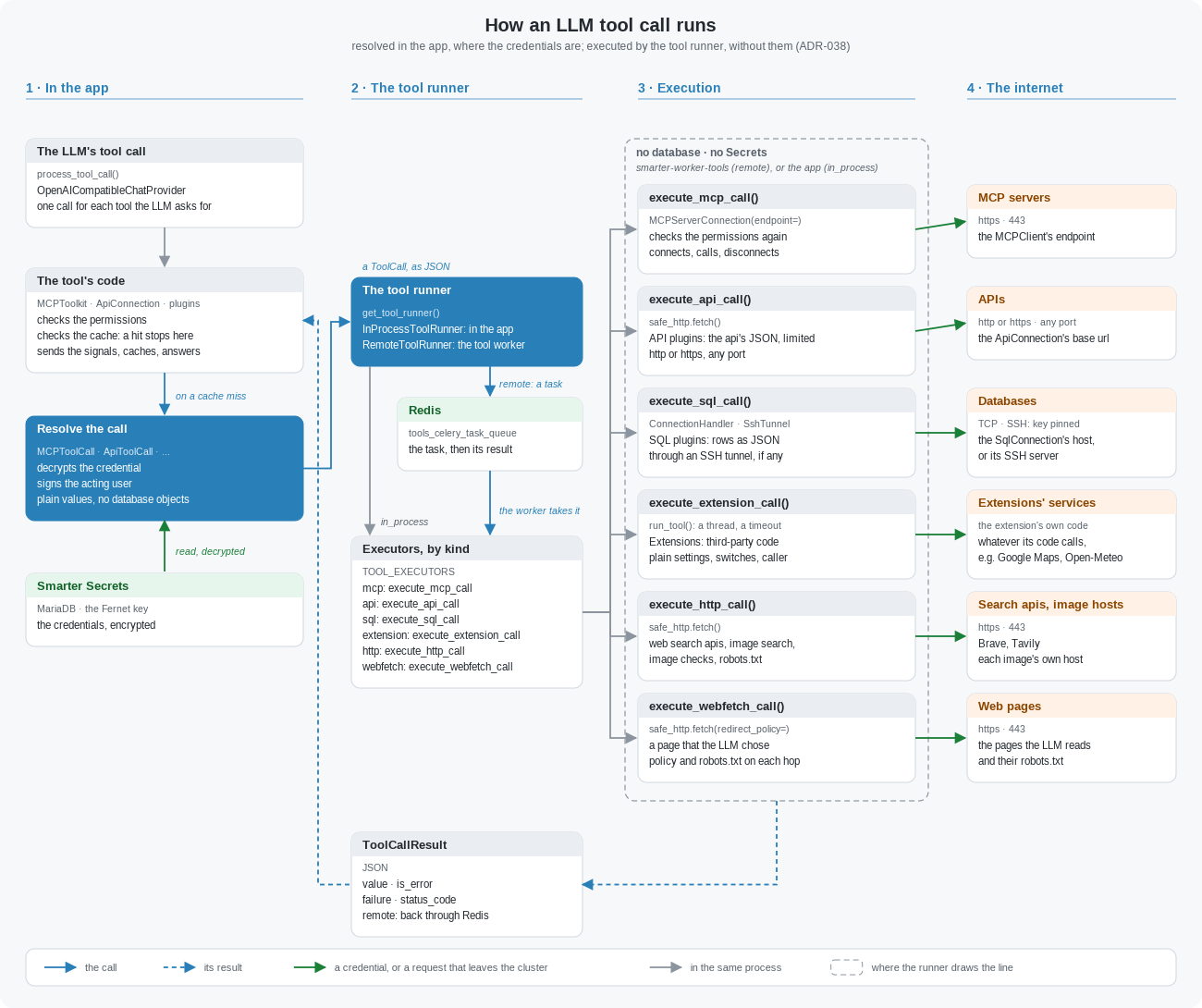
Every LLM tool call is resolved in the app into a serializable call, with the credentials it needs, and executed by the tool runner: in the app’s own process, or in the tool worker, a Celery worker that holds no credential of the platform’s (ADR-038).
The tool’s own code stays in the app, around the runner: it checks the permissions and the cache,
resolves the call only when the cache misses, so that a credential is read only for a call that
runs, and, from the result, sends the signals, stores the result in the cache and answers the LLM.
The executor of each kind of call, registered in TOOL_EXECUTORS, reads no database and no
Smarter Secret. These go through it:
MCP clients, with
smarter.apps.mcpclient.execution;API plugins, with
smarter.apps.connection.execution;SQL plugins, with
smarter.apps.connection.execution, through an SSH tunnel (smarter.apps.connection.ssh) for a connection that uses one;Extensions, with
smarter.apps.llmtool.extension.execution. Their code is a third party’s, so its context holds plain values decided before the call: its settings, its switches, and who called it, as anExtensionCaller. The executor loads an Extension’s code, its archive, by its sha256, from the cache, where the app publishes it for the remote runner, or else from the database, the first time a process runs a version;the WebsearchPlugin’s search apis (Brave, Tavily), the ImageSearchPlugin’s Brave image search and its checks of each image’s url, and every website’s robots.txt, with
smarter.apps.llmtool.runner.http. Itsfetch_with_runner()takes the place ofsafe_http.fetch(), so each of them changed by one line;the WebsearchPlugin’s fetch of a page, with
WebFetchToolCallandexecute_webfetch_call()insmarter.apps.llmtool.plugin.websearch_fetch.fetch’sredirect_policyis a function, which can’t travel with a call, so the call carries what it decides on, the domain policy and whether to obey robots.txt, and the executor builds the function where the call runs.
Choosing the runner
SMARTER_APP_LLMTOOL_TOOL_RUNNER chooses the runner that get_tool_runner()
returns:
in_process, the defaultInProcessToolRunnerexecutes each call in the process that resolved it: the app, or the Celery worker that runs an orchestration.remoteRemoteToolRunnersends each call, as JSON, in the Celery taskrun_tool_call(smarter.apps.llmtool.tasks), on the queueSMARTER_APP_TOOLS_TASKS_CELERY_TASK_QUEUE(tools_celery_task_queue), and waits for its result in the result backend, the broker’s Redis. The tool worker rebuilds the call with its kind’s model, registered inTOOL_CALL_MODELS, runs it in process, and returns its result. The app waits four times the call’s timeout, plus 15 seconds, and at most 10 minutes; a worker that doesn’t answer in that time, or a task that fails, is afailurefor the LLM, as any call that couldn’t be made is.
The tool worker, smarter-worker-tools, runs with SMARTER_DATABASE_UNAVAILABLE=true: it never opens
a database connection, reads every waffle switch as off, and starts without the Django secret key. It
takes nothing from the platform but the broker’s and the cache’s url: each call brings what it needs.
It runs without task events (no -E), which would copy each call’s arguments, and its credentials,
to Celery’s events stream. make run starts one, which takes calls only when the app’s
SMARTER_APP_LLMTOOL_TOOL_RUNNER is remote. On Kubernetes, the Helm chart’s workerTools.enabled
deploys it and makes the app’s runner remote: see The Tool Worker.
A safe HTTP request, executed by the tool runner: the http kind of tool call.
Several tools make one request to a url with smarter.apps.llmtool.plugin.safe_http.fetch(), often
with an api key in a header: the WebsearchPlugin’s search apis (Brave, Tavily), and the
ImageSearchPlugin’s Brave image search and its checks of each image’s url. fetch_with_runner()
takes the place of fetch for them. It resolves the request into an HttpToolCall, which
the tool runner executes with execute_http_call(), and turns the result back into a
SafeResponse, or raises
SafeHttpError, as fetch does. The caller is
unchanged, and the request can run in a worker without credentials (ADR-038).
fetch’s redirect_policy, a function, can’t travel with a call, so a request that needs one,
such as the WebsearchPlugin’s fetch of a page, isn’t an http call.
Nothing here logs or reads the database: the ImageSearchPlugin checks image urls in worker threads, where either would open a database connection per thread.
- smarter.apps.llmtool.runner.http.HTTP_TOOL_CALL_KIND: Final = 'http'
The
kindof a safe HTTP request, which selectsexecute_http_call().
- class smarter.apps.llmtool.runner.http.HttpToolCall(**data)[source]
Bases:
ToolCallA safe HTTP request, resolved for execution: the arguments of
fetch().Warning
headersmay hold an api key. It is excluded fromrepr(). Never log the call’smodel_dump().- json_body: JsonValue
- model_config = {'extra': 'forbid', 'frozen': True}
Configuration for the model, should be a dictionary conforming to [ConfigDict][pydantic.config.ConfigDict].
- smarter.apps.llmtool.runner.http.execute_http_call(call)[source]
Execute a resolved safe HTTP request.
- Parameters:
call (
ToolCall) – The call, anHttpToolCall.- Return type:
- Returns:
The response, from
response_to_value(), with its status code; or a result with afailure, and the status code if the server answered, whenfetchraises.- Raises:
TypeError – If the call isn’t an
HttpToolCall.
- smarter.apps.llmtool.runner.http.fetch_with_runner(url, *, method='GET', headers=None, params=None, json_body=None, timeout=15, max_bytes=2000000, max_redirects=3, accept_status=(200,), require_https=True, permit_local_loopback=False)[source]
Make a safe HTTP request through the tool runner:
fetch(), as anHttpToolCall.Its arguments are
fetch’s, but forredirect_policy, which can’t travel with a call.- Return type:
- Returns:
The response.
- Raises:
SafeHttpError – As
fetchdoes: if a url is not permitted, the request fails or times out, the response status is not accepted, or the response is too large.
- smarter.apps.llmtool.runner.http.response_to_value(response)[source]
Return a response as JSON: its url, headers and redirects, and its body in base64, so that any bytes survive.
- Parameters:
response (
SafeResponse) – The response.- Return type:
- Returns:
The JSON value of a
ToolCallResult.
- smarter.apps.llmtool.runner.http.value_to_response(value, status_code)[source]
Return the response that
response_to_value()turned into JSON.- Parameters:
value (
TypeAliasType) – The result’s value.status_code (
int) – The result’s status code.
- Return type:
- Returns:
The response.
- Raises:
SafeHttpError – If the value isn’t a response.
The call and result models of smarter.apps.llmtool.runner.
A tool call is resolved in the app, where the database and the Smarter Secrets are, into a
ToolCall: plain values, with every credential the call needs already decrypted, and
nothing that needs a database connection. A ToolRunner
executes it and returns a ToolCallResult. Both are Pydantic models, so that a call can
be sent to, and its result returned from, a worker that holds no credentials of its own (see
ADR-038).
Warning
A resolved call holds credentials. Never log it, or its model_dump(). Fields that hold
credentials are excluded from repr(), as a guard against an accidental log line.
- class smarter.apps.llmtool.runner.models.ToolCall(**data)[source]
Bases:
BaseModelA tool call, resolved for execution.
Each kind of tool subclasses it, with a
kindof its own, and registers the function that executes it insmarter.apps.llmtool.runner.runner.TOOL_EXECUTORS.- Variables:
kind – The kind of tool, e.g.
mcp. It selects the executor.
- model_config = {'extra': 'forbid', 'frozen': True}
Configuration for the model, should be a dictionary conforming to [ConfigDict][pydantic.config.ConfigDict].
- class smarter.apps.llmtool.runner.models.ToolCallLabel(**data)[source]
Bases:
BaseModelWhat a tool call is for, so that the tool worker’s log can say so.
The app sets it around each tool call that the LLM makes (
labeled_tool_calls()), and the remote runner sends it to the tool worker beside the call. It holds names and ids only, never a credential, an argument or a result: it is logged as is.- Variables:
tool – The tool’s name, as users know it, e.g. a plugin’s or an MCP tool’s name.
llmclient – The LLMClient that the call is made for, as
<name> (<id>), or None.session – The chat session’s key, masked, or None.
request_id – The id of the request that made the call, or None.
- describe()[source]
Describe the label for a log line.
- Return type:
- Returns:
e.g.
tool=stackademy_sql llmclient=stackademy (12) session=****a1b2c3 request=r-123, with-for what isn’t known.
- model_config = {'extra': 'forbid', 'frozen': True}
Configuration for the model, should be a dictionary conforming to [ConfigDict][pydantic.config.ConfigDict].
- class smarter.apps.llmtool.runner.models.ToolCallResult(**data)[source]
Bases:
BaseModelThe result of a tool call.
A call has one of three outcomes:
it succeeded:
valueis its result, andis_erroris False;the tool answered with an error of its own, e.g. an MCP tool’s
isError:valuedescribes it, andis_erroris True;it couldn’t be made: refused, unreachable, timed out or misconfigured.
failuredescribes why, andvalueis None.
An HTTP tool, e.g. an ApiPlugin’s api, also reports the response’s
status_code, so that the app can tell a rejected credential (401, 403) from any other failure.- Variables:
value – The tool’s result, as JSON.
is_error – Whether the tool answered with an error of its own.
failure – Why the call couldn’t be made, or None.
status_code – The HTTP status of an HTTP tool’s response, or None when there was none.
- model_config = {'extra': 'forbid', 'frozen': True}
Configuration for the model, should be a dictionary conforming to [ConfigDict][pydantic.config.ConfigDict].
- value: JsonValue
The tool runner: where a resolved tool call is executed.
get_tool_runner() returns the runner that every tool call goes through, as the setting
app_llmtool_tool_runner (SMARTER_APP_LLMTOOL_TOOL_RUNNER) chooses:
InProcessToolRunner, the default, executes the call in the app’s own process.RemoteToolRunnersends it, as JSON, to the tool worker,smarter-worker-tools, through the Celery queueapp_tools_tasks_celery_task_queue, and waits for its result. The worker holds no database, no Smarter Secret and no cloud credential: each call brings what it needs (ADR-038).
The code that resolves a call is the same either way. Each kind of tool registers its executor in
TOOL_EXECUTORS, and its call’s model in TOOL_CALL_MODELS, by dotted path. A path, rather
than an import, keeps this module free of the apps that it runs tools for, several of which import
from smarter.apps.llmtool.
Inside the tool worker, every call runs in process, whatever the setting says: an executor that uses
the runner itself, e.g. the web search page fetch’s robots.txt, must not send its call back to the queue
that it is serving (running_in_tool_worker()).
- class smarter.apps.llmtool.runner.runner.InProcessToolRunner[source]
Bases:
ToolRunnerExecutes each call in this process, with the executor that its kind registered.
- smarter.apps.llmtool.runner.runner.MAX_REMOTE_TIMEOUT_SECONDS = 600.0
The longest that the remote runner waits for a result.
- class smarter.apps.llmtool.runner.runner.RemoteToolRunner[source]
Bases:
ToolRunnerSends each call to the tool worker,
smarter-worker-tools, and waits for its result.The call travels as JSON, in a Celery task on the queue
app_tools_tasks_celery_task_queue, and its result comes back through the result backend, the broker’s Redis. A worker that doesn’t answer in time, or a task that fails, is a result with afailure, as any call that couldn’t be made is.Warning
The task’s arguments hold the call’s credentials, in Redis, until the worker takes the task. Smarter’s Celery app sends messages with protocol 1, which has no
argsreprheader, and its worker logs a task’s name and id, not its arguments. The tool worker runs without task events (-E), so that they don’t reach an events stream either.
- smarter.apps.llmtool.runner.runner.TOOL_CALL_MODELS: dict[str, str] = {'api': 'smarter.apps.connection.execution.ApiToolCall', 'extension': 'smarter.apps.llmtool.extension.execution.ExtensionToolCall', 'http': 'smarter.apps.llmtool.runner.http.HttpToolCall', 'mcp': 'smarter.apps.mcpclient.execution.MCPToolCall', 'sql': 'smarter.apps.connection.execution.SqlToolCall', 'webfetch': 'smarter.apps.llmtool.plugin.websearch_fetch.WebFetchToolCall'}
Each kind of tool call, and the dotted path of its model, which rebuilds a call from its JSON in the tool worker.
{
    'api': 'smarter.apps.connection.execution.ApiToolCall',
    'extension': 'smarter.apps.llmtool.extension.execution.ExtensionToolCall',
    'http': 'smarter.apps.llmtool.runner.http.HttpToolCall',
    'mcp': 'smarter.apps.mcpclient.execution.MCPToolCall',
    'sql': 'smarter.apps.connection.execution.SqlToolCall',
    'webfetch': 'smarter.apps.llmtool.plugin.websearch_fetch.WebFetchToolCall',
}
- smarter.apps.llmtool.runner.runner.TOOL_EXECUTORS: dict[str, str] = {'api': 'smarter.apps.connection.execution.execute_api_call', 'extension': 'smarter.apps.llmtool.extension.execution.execute_extension_call', 'http': 'smarter.apps.llmtool.runner.http.execute_http_call', 'mcp': 'smarter.apps.mcpclient.execution.execute_mcp_call', 'sql': 'smarter.apps.connection.execution.execute_sql_call', 'webfetch': 'smarter.apps.llmtool.plugin.websearch_fetch.execute_webfetch_call'}
Each kind of
ToolCall, and the dotted path of its executor.{ 'api': 'smarter.apps.connection.execution.execute_api_call', 'extension': 'smarter.apps.llmtool.extension.execution.execute_extension_call', 'http': 'smarter.apps.llmtool.runner.http.execute_http_call', 'mcp': 'smarter.apps.mcpclient.execution.execute_mcp_call', 'sql': 'smarter.apps.connection.execution.execute_sql_call', 'webfetch': 'smarter.apps.llmtool.plugin.websearch_fetch.execute_webfetch_call', }
- smarter.apps.llmtool.runner.runner.ToolExecutor
A function that executes one kind of resolved tool call, and returns its result.
alias of
Callable[[ToolCall],ToolCallResult]
- class smarter.apps.llmtool.runner.runner.ToolRunner[source]
Bases:
ABCExecutes resolved tool calls.
- smarter.apps.llmtool.runner.runner.call_model_for(kind)[source]
Return the model of a kind of tool call.
- smarter.apps.llmtool.runner.runner.call_timeout(call)[source]
Return the timeout that a call names, its own or its MCP endpoint’s.
- smarter.apps.llmtool.runner.runner.carry_tool_call_label(function)[source]
Return a function that runs
functionwith the current tool call label.A thread doesn’t inherit the context variables of the code that starts it, so a call made from a thread pool, e.g. an ImageSearchPlugin’s validation of image urls, would lose its label.
- smarter.apps.llmtool.runner.runner.current_tool_call_label()[source]
Return the label that
labeled_tool_calls()set, if any.- Return type:
- Returns:
The label, or None.
- smarter.apps.llmtool.runner.runner.describe_remote_failure(error, timeout)[source]
Describe, for the LLM, why the tool worker didn’t return a call’s result.
- smarter.apps.llmtool.runner.runner.executor_for(kind)[source]
Return the executor of a kind of tool call.
- Parameters:
kind (
str) – The call’skind.- Return type:
- Returns:
The executor.
- Raises:
SmarterConfigurationError – If no executor is registered for the kind.
- smarter.apps.llmtool.runner.runner.get_tool_runner()[source]
Return the runner that tool calls go through.
- Return type:
- Returns:
RemoteToolRunnerwhenapp_llmtool_tool_runnerisremote, outside the tool worker; otherwiseInProcessToolRunner.
- smarter.apps.llmtool.runner.runner.labeled_tool_calls(label)[source]
Label every tool call made inside the
withblock, so that the tool worker’s log says what it was for.The chat provider sets it around each tool call that the LLM makes (
OpenAICompatibleChatProvider.process_tool_call()). A call made without one is logged without it.- Parameters:
label (
ToolCallLabel) – The label, names and ids only.- Return type:
- smarter.apps.llmtool.runner.runner.remote_timeout(call)[source]
Return how long the remote runner waits for a call’s result.
- Parameters:
call (
ToolCall) – The call.- Return type:
- Returns:
Seconds: the call’s timeout times
REMOTE_TIMEOUT_FACTOR, plusREMOTE_TIMEOUT_MARGIN_SECONDS, at mostMAX_REMOTE_TIMEOUT_SECONDS.
- smarter.apps.llmtool.runner.runner.running_in_tool_worker()[source]
Mark the code inside the
withblock as running in the tool worker, so thatget_tool_runner()runs its calls in process.The tool worker’s task,
smarter.apps.llmtool.tasks.run_tool_call(), runs each call inside it.