Smarter Development Framework
The Smarter Development Framework is an opinionated, cloud-native application framework for building, deploying, and managing AI-powered applications at scale. Developers declare AI resources, services, configurations, and dependencies in Smarter Manifests, a standardized YAML specification, and the platform does the rest: deployment, governance, cost management, versioning, and operations.
Around the platform is an ecosystem of open-source packages, each published to the registry its users already know: PyPI, npm, Homebrew, APT, Chocolatey, the VS Code Marketplace, Docker Hub, Artifact Hub, and Go modules. Every one of them is a client of the same Smarter API and its OpenAPI contract, or a building block that the platform and those clients share.
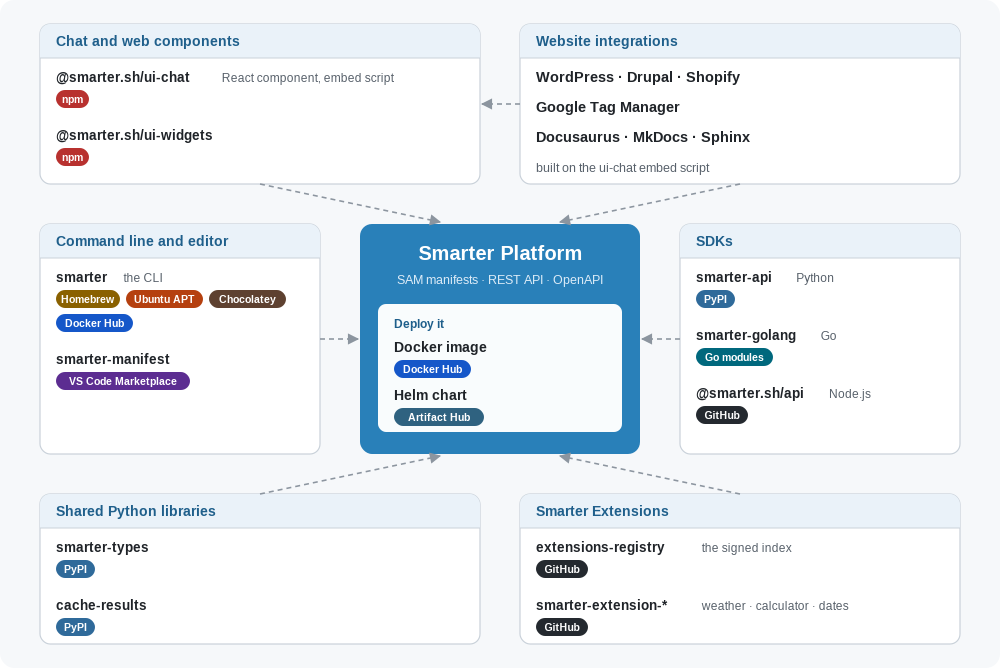
The Smarter Ecosystem
All of these packages are open source, and their source is in the smarter-sh organization on GitHub.
Command Line and Editor
The Smarter CLI, smarter, works like kubectl: it
applies, describes, deploys and deletes resources from a terminal or a shell script.
# macOS and Linux, with Homebrew
brew tap smarter-sh/tap https://github.com/smarter-sh/homebrew-tap
brew trust smarter-sh/tap
brew install smarter

# Ubuntu
sudo add-apt-repository ppa:lpm0073/smarter-cli
sudo apt-get update
sudo apt-get install smarter-cli

# Windows
choco install smarter
It is also a Docker image, mcdaniel0073/smarter-cli, and a binary for every platform on its releases page.
Package |
Published on |
What it is |
|---|---|---|
|
Homebrew, Ubuntu APT, Chocolatey, Docker Hub |
The Smarter CLI. |
Smarter Manifest |
The VS Code extension: validation and completion of manifests as you type, and the CLI’s validate, apply and deploy commands. |
SDKs
Libraries that give your own software typed, complete access to a Smarter platform. They have the same resources, verbs and errors in every language.
Package |
Published on |
What it is |
|---|---|---|
|
The Python SDK, |
|
|
The Go SDK,
|
|
|
The Node.js SDK, for JavaScript and TypeScript. |
Chat and Web Components
Package |
Published on |
What it is |
|---|---|---|
|
Smarter Chat, the chat UI of a deployed LLMClient: a
React component, |
|
|
The web console’s dashboard widgets, which smarter.sh also uses. |
The website integrations for WordPress, Drupal, Shopify, Google Tag Manager, and Docusaurus, MkDocs and Sphinx documentation sites are built on Smarter Chat’s embed script, and add a deployed LLMClient’s chat to a site from a settings screen.
Running the Platform
Package |
Published on |
What it is |
|---|---|---|
|
The platform’s Docker image. |
|
|
Smarter on Kubernetes,
|
Extending Smarter
Smarter is extended in two ways, with Plugins and Extensions: Plugins are YAML manifests that configure Smarter’s built-in tool patterns, and Extensions are Python packages that platform administrators install at run time, from the signed index in smarter-sh/extensions-registry. Ready-made manifests for every kind are in smarter-sh/example-manifests.
How the Framework Fits Together
At the center of the framework is declarative resource management. A manifest declares what a resource should be, and the Smarter Broker Model makes it so. Teams focus on application design and business logic rather than deployment mechanics and platform integration.
The manifests, the API, its OpenAPI contract, the CLI, the SDKs and the website integrations are grouped under Smarter APIs, SDKs and Integrations, which also presents the design goals that the APIs and SDKs share.
Smarter is built on proven open-source technologies, including Kubernetes, Docker, Django, React, TypeScript, and Pydantic, and extends them with standardized APIs, automation, and developer tooling designed for AI applications.
This section of the documentation is the technical reference for the framework, including its architecture, specifications, APIs, command-line tools, SDKs, and supporting technologies.